
How 5 Axis Waterjet Cutting Improves Manufacturing Precision
In today's highly competitive manufacturing industry, precision is no longer just a quality standard—it is a business advantage. Whether producing aerospace components, architectural stone, automotive parts, or custom metal fabrications, manufacturers are expected to deliver increasingly complex designs with tighter tolerances and shorter lead times. Traditional cutting methods often struggle to meet these developing requirements without compromising material quality or production efficiency.
This is where 5-axis waterjet cutting has become a game-changing technology. By combining ultra-high-pressure water with advanced CNC motion control, a 5-axis waterjet cutting system enables manufacturers to produce parts with exceptional accuracy while eliminating heat-related damage. Its ability to cut virtually any material, regardless of hardness or thickness, makes it one of the most versatile solutions available for modern fabrication.
In this article, we'll explore how 5-axis waterjet cutting improves manufacturing precision, why it outperforms conventional cutting methods, and which industries benefit the most from this advanced technology.
What Is 5 Axis Waterjet Cutting?
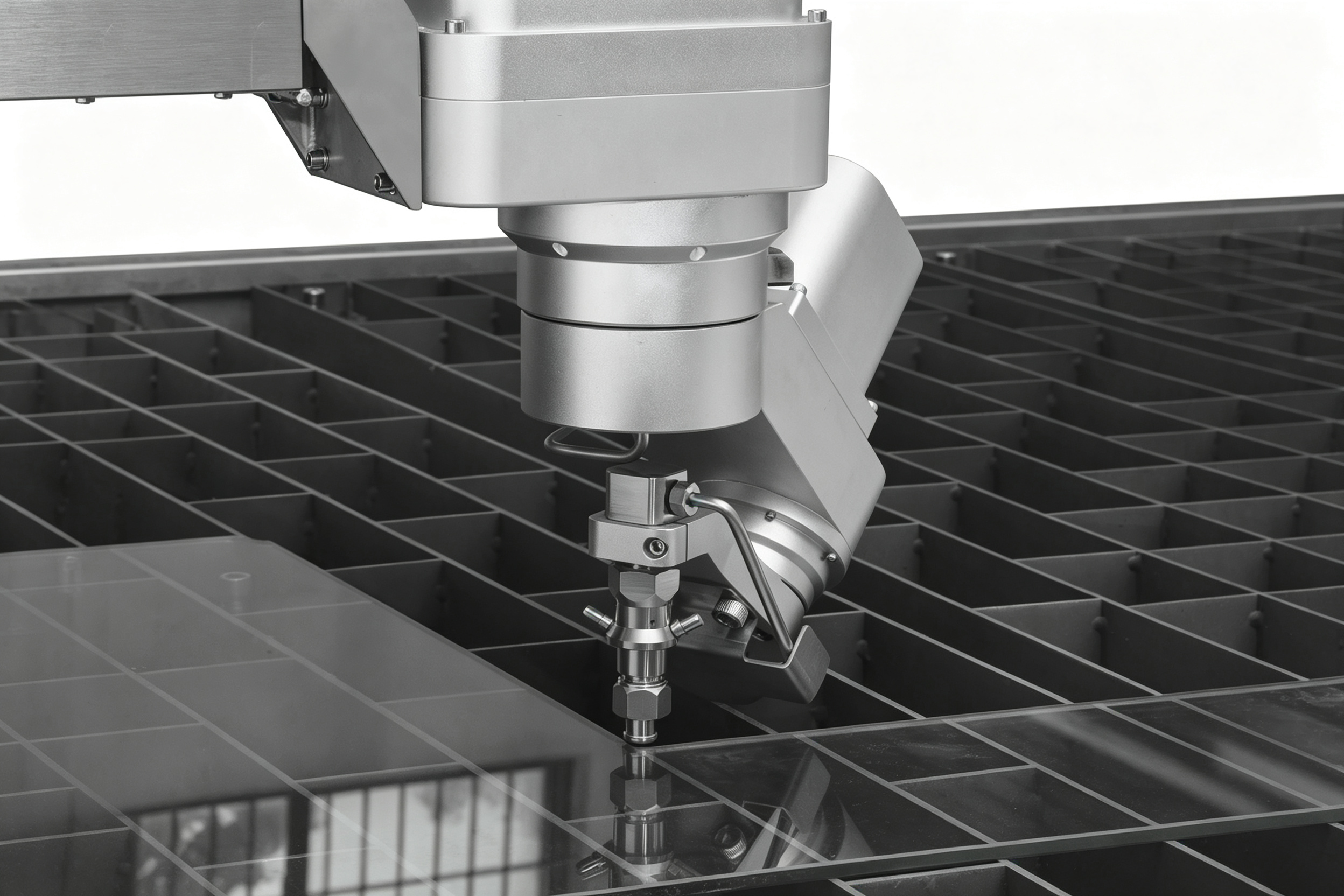
A 5-axis waterjet cutting machine is an advanced CNC-controlled system that moves the cutting head along five independent axes. Unlike traditional 2D or 3-axis waterjet machines, the cutting head can tilt and rotate while moving across the workpiece.
This additional flexibility allows the machine to produce:
- Complex three-dimensional geometries
- Beveled and angled cuts
- Smooth edge finishes
- Complex internal contours
- High-precision joints and assemblies
The cutting process uses ultra-high-pressure water, often exceeding 60,000 PSI, mixed with abrasive garnet for hard materials such as steel, granite, marble, titanium, glass, and ceramics. Since the process is entirely cold, it avoids the thermal distortion associated with laser, plasma, or flame cutting.
Why Manufacturing Precision Matters
Precision directly affects product quality, assembly performance, production costs, and customer satisfaction. Even minor dimensional errors can lead to component failure, material waste, or expensive rework.
Modern manufacturers face several challenges:
- Increasingly complex product designs
- Tight tolerance requirements
- Expensive engineering materials
- Reduced production timelines
- Higher customer quality expectations
A manufacturing process capable of consistently producing accurate parts on the first attempt greatly reduces operational costs while improving overall productivity.
Five Ways 5 Axis Waterjet Cutting Improves Manufacturing Precision
1. Superior Accuracy for Complex Geometries
One of the biggest advantages of 5-axis waterjet cutting is its ability to manufacture precision components with remarkable dimensional accuracy.
The tilting cutting head automatically compensates for taper, allowing nearly vertical edges and highly accurate profiles. This is particularly valuable when producing:
- Aerospace brackets
- Medical components
- Decorative stone inlays
- Mechanical parts
- Precision molds
Instead of requiring multiple machining operations, manufacturers can complete many complex cuts in a single setup, reducing accumulated positioning errors.
2. Eliminates Heat-Affected Zones
Unlike laser or plasma cutting, waterjet technology generates virtually no heat during processing.
This means there is:
- No thermal distortion
- No material hardening
- No melting
- No micro-cracking
- No heat-affected zone (HAZ)
Materials retain their original mechanical and structural properties after cutting.
This benefit is especially important when machining:
- Stainless steel
- Titanium
- Aluminum alloys
- Carbon fiber composites
- Tempered glass
- Natural stone
The absence of heat ensures higher dimensional stability and reduces secondary finishing operations.
3. Produces Smooth, Clean Edge Quality
Edge quality directly impacts assembly accuracy and final product appearance.
Because the abrasive water stream erodes material instead of melting it, the finished edge is exceptionally smooth with minimal burr formation.
Manufacturers often experience:
- Reduced grinding requirements
- Less polishing
- Improved fit between components
- Faster assembly
- Better aesthetic quality
For industries such as architectural stone fabrication, decorative metal panels, and luxury interior design, clean edge quality remarkably improves product value.
4. Maintains Precision Across Thick Materials
Traditional cutting methods often lose accuracy as material thickness increases.
A 5 axis waterjet cutting machine maintains excellent precision even when processing thick materials because the cutting head automatically compensates for jet lag and taper.
Examples include:
- Thick steel plates
- Marble slabs
- Granite countertops
- Composite panels
- Aluminum blocks
- Engineering plastics
This capability enables manufacturers to produce accurate parts without sacrificing edge quality or dimensional consistency.
5. Reduces Secondary Machining
Every additional machining operation introduces opportunities for dimensional error.
Because 5-axis waterjet cutting can produce bevels, countersinks, chamfers, and complex angles directly, manufacturers often eliminate several downstream processes.
Benefits include:
- Fewer machine setups
- Lower labor costs
- Shorter production cycles
- Improved repeatability
- Higher production efficiency
The result is greater overall manufacturing precision while lowering total production costs.
Materials That Benefit from 5 Axis Waterjet Cutting
One reason manufacturers increasingly adopt 5-axis waterjet cutting is its exceptional material versatility.
Common materials include:
Metals
- Stainless steel
- Carbon steel
- Aluminum
- Copper
- Brass
- Titanium
Stone
Natural stone processing greatly benefits from the precision of waterjet technology.
Common applications include:
- Marble mosaics
- Granite countertops
- Quartz surfaces
- Decorative stone panels
- Custom medallions
Detailed curves and artistic patterns can be cut without damaging delicate materials.
Ceramics and Glass
Cold cutting prevents cracking and thermal stress, making waterjet ideal for:
- Ceramic tiles
- Porcelain slabs
- Tempered glass
- Laminated glass
- Decorative glass panels
Composite Materials
Advanced industries frequently machine:
- Carbon fiber
- Fiberglass
- Kevlar
- Honeycomb panels
- Engineering plastics
Waterjet cutting prevents delamination while maintaining clean edges.
Industries That Rely on High-Precision Waterjet Cutting
The precision of 5-axis waterjet cutting has made it an essential manufacturing technology across multiple industries.
Aerospace Manufacturing
Aircraft components require exceptional dimensional accuracy while maintaining material integrity.
Waterjet cutting minimizes thermal stress and delivers precise complex profiles for lightweight alloys and composites.
Automotive Industry
Manufacturers use waterjet systems for:
- Prototype development
- Interior components
- Chassis parts
- Battery trays
- Aluminum structures
Fast programming enables expedited product development with minimal tooling investment.
Stone Fabrication
Architectural stone manufacturers produce:
- Luxury flooring
- Waterjet mosaics
- Decorative wall panels
- Kitchen countertops
- Custom medallions
The technology allows unlimited design flexibility while preserving fragile stone materials.
Metal Fabrication
Precision sheet metal manufacturers benefit from:
- High repeatability
- Minimal material waste
- Accurate bevel cutting
- Reduced finishing requirements
This improves both production efficiency and product quality.
Additional Advantages Beyond Precision
Although manufacturing precision is the primary benefit, 5 axis waterjet cutting also improves overall operational performance.
Additional advantages include:
- High material utilization
- Minimal waste generation
- Environmentally friendly cold cutting
- Low tooling wear
- Flexible production scheduling
- Quick transition between different materials
- Excellent repeatability for batch production
These advantages help manufacturers remain competitive while meeting increasingly demanding customer expectations.
Choosing the Right 5 Axis Waterjet Cutting Machine
Not every waterjet system offers the same level of performance.
When selecting equipment, manufacturers should evaluate:
- CNC control accuracy
- Maximum cutting pressure
- Five-axis motion capability
- Automatic taper compensation
- Software compatibility
- Machine rigidity
- Cutting table size
- Service and technical support
Investing in a high-quality machine ensures consistent precision over years of continuous operation while reducing maintenance costs and downtime.
Conclusion
As product designs become more sophisticated and manufacturing tolerances continue to tighten, precision cutting technology has become a critical competitive advantage. 5-axis waterjet cutting delivers the accuracy, flexibility, and material versatility required for today's demanding production environments.
By eliminating heat distortion, compensating for taper, producing smooth edge finishes, and accurately machining complex geometries, this technology enables manufacturers to achieve superior part quality while reducing production costs and shortening lead times.
Whether you manufacture aerospace components, precision metal parts, architectural stone products, or advanced composite materials, investing in a modern 5-axis waterjet cutting solution can distinctly improve manufacturing precision, operational efficiency, and long-term business performance.
Recent Posts
- Invitation | DEFA TECHNOLOGY invites you to visit
- Foshan DEFA Technology Co., Ltd invites you to participate in the GLASSTEC Düsseldorf Glass Fair in Germany in 2024
- Foshan DEFA Technology Co., Ltd invites you to participate in the Glasstech Asia & Fenestration Asia in Indonesia in 2025
- Hannover MESse Shanghai 2024
- Cutting product display
SUBSCRIBE
INQUIRY