
Water Jet Cutting vs CNC Milling: Complete Comparison
Manufacturers today have access to a wide variety of precision machining technologies, each designed to meet different production requirements. Among the most commonly used methods, water jet cutting and CNC milling are often compared because both rely on CNC automation while serving very different manufacturing purposes. Choosing the right process affects not only production costs but also material utilization, product quality, and overall manufacturing efficiency.
Although these technologies are sometimes viewed as competitors, they actually complement one another in many production environments. Water jet cutting specializes in cold cutting a broad range of materials without thermal damage, while CNC milling excels at creating complex three-dimensional features with exceptional dimensional accuracy. Understanding the differences between the two processes allows manufacturers to select the most effective solution for each project.
This article explores how water jet cutting and CNC milling work, compares their capabilities, and explains which process is best suited for different manufacturing applications.
What Is Water Jet Cutting?
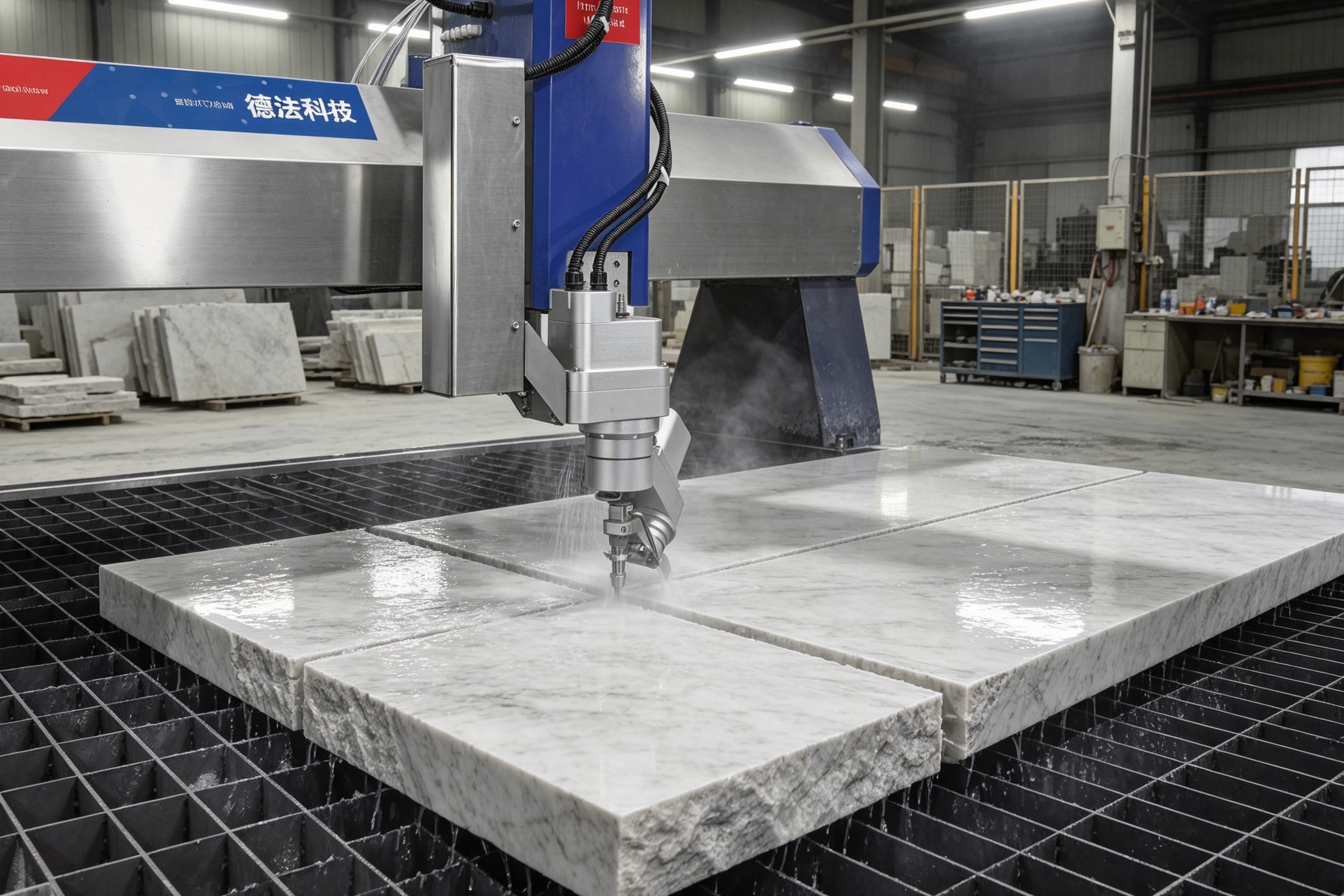
Water jet cutting is a non-thermal machining process that removes material using an extremely high-pressure stream of water. For metals and other hard materials, abrasive particles such as garnet are added to the water stream, enabling the machine to cut stainless steel, aluminum, titanium, ceramics, stone, and composite materials with remarkable precision.
One of the biggest advantages of water jet cutting is that it generates virtually no heat during processing. Unlike laser cutting or plasma cutting, the material retains its original mechanical properties because there is no heat-affected zone. This makes water jet cutting particularly suitable for aerospace alloys, hardened steels, laminated composites, rubber, plastics, and other heat-sensitive materials.
Modern CNC water jet systems can produce highly tricky cutting paths while maintaining excellent edge quality. Since the cutting head never physically contacts the workpiece, there is minimal mechanical stress on the material, reducing the likelihood of deformation or cracking during processing.
What Is CNC Milling?
CNC milling is a subtractive manufacturing process in which rotating cutting tools gradually remove material from a workpiece to create the desired geometry. Controlled by sophisticated CNC software, milling machines can perform drilling, slotting, pocketing, contouring, threading, and three-dimensional machining within a single setup.
Unlike water jet cutting, CNC milling relies on direct contact between the cutting tool and the material. Different cutting tools are selected depending on the material type, machining strategy, and required surface finish. Because of its versatility, CNC milling has become one of the most important manufacturing technologies for producing precision mechanical components.
The ability to create deep cavities, precise holes, threaded features, and complex curved surfaces makes CNC milling indispensable in industries such as aerospace, automotive, robotics, mold manufacturing, and medical device production.
Comparing Cutting Performance
Although both technologies deliver excellent accuracy, their cutting characteristics are fundamentally different. Water jet cutting is primarily designed for profile cutting. It efficiently processes flat sheets of metal, stone, glass, composite materials, and plastics while maintaining excellent edge quality and minimizing material waste. Since there is no heat generation, even thick materials can be cut without distortion or metallurgical changes.
CNC milling, on the other hand, focuses on material removal rather than profile cutting alone. It enables manufacturers to produce sophisticated three-dimensional parts with extremely tight tolerances. Components requiring internal pockets, stepped surfaces, precision holes, or threaded features generally require CNC milling because these geometries cannot be achieved through water jet cutting alone.
For manufacturers producing structural plates, decorative panels, or flat components, water jet cutting often offers greater efficiency. However, when producing mechanical parts with complex geometries, CNC milling remains the superior choice.
Material Compatibility
Material compatibility is another important factor when selecting a manufacturing process. Water jet cutting is recognized for its exceptional versatility because it can process almost any material regardless of hardness. Metals, ceramics, marble, granite, glass, carbon fiber, rubber, foam, plastics, and even food products can all be cut using the same machine with appropriate cutting parameters.
CNC milling also supports a wide range of materials but performs best with metals and engineering plastics. Aluminum, stainless steel, titanium, brass, copper, and high-performance polymers are commonly machined using CNC milling. Brittle materials such as glass and ceramic, however, present huge challenges because mechanical cutting forces may cause cracking or chipping.
For manufacturers working with multiple material types, water jet cutting often provides greater flexibility.
Precision and Surface Quality
Both manufacturing methods are capable of producing highly accurate components, although their strengths differ depending on the application. Water jet cutting generally achieves tolerances suitable for most industrial cutting applications while producing smooth edges that often require little or no secondary finishing.
CNC milling provides even higher dimensional accuracy and superior control over three-dimensional features. Because the cutting tool follows precisely programmed toolpaths, manufacturers can achieve extremely tight tolerances for aerospace components, medical devices, and precision machinery.
Surface finish also varies depending on the machining strategy. Water jet cutting leaves a uniform edge with minimal burrs, whereas CNC milling can produce exceptionally smooth machined surfaces through finishing operations using specialized cutting tools.
Cost and Production Efficiency
The overall cost of manufacturing depends on production volume, material type, and part complexity. Water jet cutting generally requires lower setup time because there are no cutting tools to replace or recalibrate for different materials. It is particularly economical for low- to medium-volume production and custom fabrication projects.
CNC milling typically involves higher tooling costs and longer programming times. Cutting tools gradually wear during machining and require regular replacement to maintain machining accuracy. However, when producing complex mechanical parts that require multiple machining operations, CNC milling often becomes more cost-effective because drilling, pocketing, threading, and finishing can all be completed within a single machine.
Many manufacturers combine the two technologies by first using water jet cutting to produce near-net-shape blanks before performing precision finishing on a CNC milling machine. This hybrid workflow reduces machining time while improving material utilization.
Which Technology Is Right for Your Business?
Rather than asking whether water jet cutting is better than CNC milling, manufacturers should consider which technology best matches their production requirements. Water jet cutting is the preferred solution for cutting thick materials, heat-sensitive alloys, composites, stone, glass, and large sheet materials while preserving material integrity. It is especially valuable when clean edges and minimal thermal impact are essential.
CNC milling becomes the better choice whenever a component requires complex three-dimensional geometry, precision holes, threaded features, or extremely tight tolerances. Industries that demand highly engineered mechanical components continue to rely on CNC milling because of its unmatched machining flexibility.
For many modern manufacturing facilities, integrating both technologies provides the greatest competitive advantage. Water jet cutting delivers efficient material preparation, while CNC milling completes high-precision machining operations, resulting in faster production cycles and lower overall manufacturing costs.
Conclusion
Water jet cutting and CNC milling are not competing technologies but complementary manufacturing solutions that address different production challenges. Water jet cutting offers unmatched versatility, excellent material compatibility, and cold-cutting capabilities that preserve material properties. CNC milling delivers exceptional precision, advanced three-dimensional machining, and the ability to manufacture highly complex mechanical components.
By understanding the strengths of each process, manufacturers can make wise decisions that improve product quality, reduce production costs, and optimize manufacturing efficiency. Whether your application involves sheet metal fabrication, aerospace components, stone processing, or precision engineering, selecting the right machining technology is the key to achieving long-term production success.
Recent Posts
- Invitation | DEFA TECHNOLOGY invites you to visit
- Foshan DEFA Technology Co., Ltd invites you to participate in the GLASSTEC Düsseldorf Glass Fair in Germany in 2024
- Foshan DEFA Technology Co., Ltd invites you to participate in the Glasstech Asia & Fenestration Asia in Indonesia in 2025
- Hannover MESse Shanghai 2024
- Cutting product display
SUBSCRIBE
INQUIRY