
Water Jet vs Bridge Saw for Tile Cutting
Choosing the right cutting technology is one of the most important decisions in tile manufacturing and fabrication. Whether you produce ceramic tiles, porcelain slabs, natural stone, or custom decorative pieces, the cutting method directly influences product quality, production efficiency, material utilization, and overall operating costs. Among today's most widely used cutting solutions, water jet cutting machines and bridge saws are the two leading options. While both are capable of processing a wide variety of tile materials, they are designed for different production needs and excel in different applications.
If you are comparing water jet vs bridge saw for tile cutting, understanding the strengths and limitations of each technology will help you choose the most suitable equipment for your business.
What Is Water Jet Tile Cutting?
Water jet cutting uses an ultra-high-pressure stream of water, often combined with abrasive garnet, to cut through hard materials. Unlike conventional cutting methods, the process generates virtually no heat, making it a cold-cutting technology that preserves the physical properties of the material.
This technology has become increasingly popular for processing ceramic tiles, porcelain, marble, granite, quartz, glass, and engineered stone because it minimizes the risk of thermal damage, edge chipping, and cracking. Water jet machines can cut almost any two-dimensional shape directly from CAD drawings, making them ideal for custom tile fabrication, decorative mosaics, logos, medallions, and architectural designs.
Because the cutting stream is extremely narrow, water jet systems also reduce material waste while producing highly accurate finished components.
Understanding Bridge Saw Technology
A bridge saw is one of the most established cutting machines in the stone and tile industry. It uses a rotating diamond blade mounted on a bridge structure to perform straight-line cuts across slabs or tiles. Modern CNC bridge saws incorporate automatic positioning, programmable movement, and multiple cutting angles to improve production efficiency.
Bridge saws are widely used for trimming slabs, producing standard tile sizes, creating miter cuts, and processing countertops. They are particularly effective in high-volume manufacturing environments where repetitive straight cuts are required.
Although advanced bridge saws offer greater flexibility than traditional manual machines, they remain primarily optimized for linear cutting rather than tricky profiles.
Precision and Cutting Accuracy
Both technologies are capable of producing accurate cuts, but they achieve precision in different ways.
Water jet cutting delivers exceptional accuracy for both simple and highly complex geometries. The fine cutting stream allows manufacturers to create sharp internal corners, difficult curves, detailed patterns, and complex decorative elements without introducing mechanical stress to the material. This makes water jet technology especially valuable for luxury tile collections and customized architectural projects.
Bridge saws also provide excellent dimensional accuracy, particularly when performing straight cuts or repetitive production. However, because cutting is performed with a circular blade, internal corners naturally have a radius, limiting the machine's ability to create highly detailed shapes. For standard tile production, this limitation is rarely an issue, but for artistic designs, water jet cutting clearly offers greater flexibility.
Edge Quality and Finished Appearance
Edge quality often determines whether additional finishing processes are required after cutting.
Water jet cutting produces smooth, clean edges with minimal chipping. Since there is no direct contact between a blade and the workpiece, fragile porcelain tiles and polished stone surfaces experience less mechanical stress during processing. This often eliminates the step for secondary grinding or polishing, saving both time and labor.
Bridge saws can also generate high-quality edges when equipped with premium diamond blades and properly adjusted cutting parameters. However, blade wear gradually affects cutting performance, and brittle materials may develop small chips if the blade becomes dull or feed rates are too aggressive. Regular blade maintenance is therefore essential to maintain consistent product quality.
Flexibility for Custom Tile Designs
Today's construction and interior design markets increasingly demand customized tile solutions rather than standard rectangular products. This trend has greatly increased the value of water jet cutting technology.
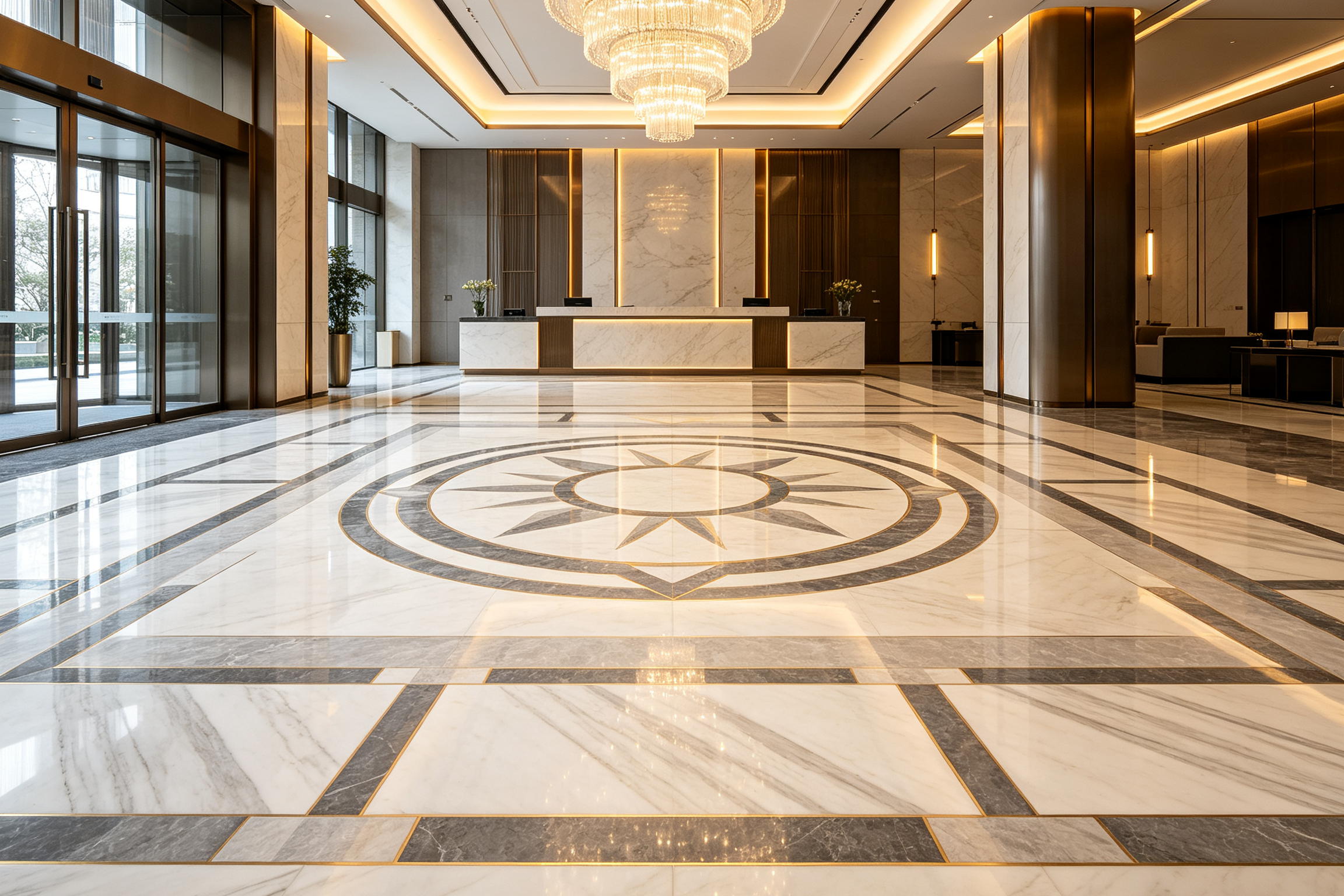
Water jet machines can produce virtually unlimited shapes, including curves, circles, decorative borders, company logos, geometric patterns, floral mosaics, and complex inlays. Designers can create sophisticated floor medallions or wall decorations directly from digital design files without requiring additional machining.
Bridge saws, by comparison, are best suited for straight cuts, angle cuts, and basic shaping operations. Although some CNC bridge saws can perform limited contour cutting, they cannot match the design freedom offered by water jet systems. Manufacturers focused on premium customized products generally benefit far more from the versatility of water jet technology.
Material Compatibility
Another important factor when comparing water jet and bridge saw systems is material compatibility.
Water jet cutting machines are capable of processing an extensive range of materials using the same cutting head. Ceramic, porcelain, marble, granite, quartz, glass, engineered stone, composite panels, and even metal inserts can all be cut without changing tools. This versatility makes water jet systems particularly attractive for manufacturers serving multiple industries or offering customized products.
Bridge saws also process most common tile and stone materials effectively. However, different materials often require different diamond blades to achieve optimal cutting performance. While this is not a clear disadvantage for dedicated production lines, it does reduce operational flexibility compared to water jet technology.
Cutting Speed and Production Efficiency
Production speed is often a deciding factor when selecting industrial equipment.
For long, straight cuts, bridge saws generally outperform water jet machines in terms of cutting speed. Their continuously rotating diamond blades allow fast processing of standard tiles and slabs, making them ideal for mass production environments where efficiency is the highest priority.
Water jet cutting is typically slower because material removal occurs through high-pressure erosion rather than mechanical sawing. However, evaluating productivity solely by cutting speed can be misleading. Water jet machines frequently eliminate additional finishing operations, reduce rejected parts, minimize breakage, and complete fancy designs in a single setup. For custom manufacturing, these advantages often outweigh the slower cutting process.
Material Utilization and Waste Reduction
Material costs continue to increase, especially for premium porcelain and natural stone. Maximizing yield has therefore become a major concern for manufacturers.
Water jet cutting uses an extremely narrow kerf, allowing parts to be nested much closer together, which reduces material waste, improves slab utilization, and lowers production costs over time. The reduced cutting force also decreases the likelihood of damaged parts during fabrication.
Bridge saws remove more material because of the wider diamond blade thickness. Although the difference may seem relatively small on individual cuts, it becomes increasingly important when processing expensive stone slabs or high-volume production batches.
Maintenance and Operating Costs
Every cutting technology requires routine maintenance, but the maintenance requirements differ considerably.
Water jet systems rely on high-pressure pumps and precision components. Consumables such as nozzles, orifices, seals, and abrasive delivery systems require regular replacement to maintain cutting performance. Abrasive garnet also represents an ongoing operating expense that should be included when calculating production costs.
Bridge saw maintenance is generally simpler. Operators mainly replace worn diamond blades, inspect bearings, maintain guide rails, and service cooling systems. For businesses producing large quantities of standard products, bridge saws often offer lower daily operating costs.
However, when manufacturing complex, high-value components, the additional flexibility and reduced secondary processing offered by water jet systems can produce a better overall return on investment.
Which Machine Is Better for Tile Cutting?
There is no universal answer because the ideal solution depends on production objectives.
If your business primarily manufactures standard tile sizes, performs straight cuts, and focuses on high-volume production, a bridge saw provides excellent speed, reliability, and cost efficiency. It remains one of the most productive solutions for conventional tile fabrication.
On the other hand, if your customers require customized products, decorative mosaics, complex stone inlays, luxury porcelain panels, or unique architectural designs, a water jet cutting machine is the superior choice. Its exceptional precision, outstanding edge quality, and virtually unlimited design flexibility make it an invaluable investment for manufacturers seeking to differentiate themselves in competitive markets.
Many modern fabrication facilities choose not to replace one technology with the other but instead integrate both into their production workflow. Bridge saws perform fast primary cutting, while water jet systems complete precision shaping and decorative detailing. This combination delivers the productivity of conventional sawing alongside the design capabilities of advanced water jet technology.
Conclusion
The comparison between water jet vs bridge saw for tile cutting comes down to balancing speed, precision, flexibility, and production requirements. Bridge saws continue to dominate applications involving straight cuts and large-scale manufacturing, offering fast processing and relatively low operating costs. Water jet cutting, meanwhile, has become the preferred solution for premium tile fabrication thanks to its cold-cutting process, superior edge quality, minimal material waste, and ability to create virtually any design.
As demand for customized architectural surfaces and high-end porcelain products continues to grow, more manufacturers are investing in water jet technology to expand their production capabilities. For companies seeking maximum efficiency across diverse projects, combining bridge saws with water jet cutting systems often provides the most competitive and future-ready manufacturing solution.
Recent Posts
- Invitation | DEFA TECHNOLOGY invites you to visit
- Foshan DEFA Technology Co., Ltd invites you to participate in the GLASSTEC Düsseldorf Glass Fair in Germany in 2024
- Foshan DEFA Technology Co., Ltd invites you to participate in the Glasstech Asia & Fenestration Asia in Indonesia in 2025
- Hannover MESse Shanghai 2024
- Cutting product display
SUBSCRIBE
INQUIRY