
Waterjet Cutting Tempered Glass: Challenges and Alternatives
Tempered glass is widely recognized for its exceptional strength, impact resistance, and safety characteristics. It is commonly used in commercial buildings, automotive windows, shower enclosures, electronic displays, and modern interior design. As waterjet cutting continues to gain popularity for processing metals, stone, ceramics, and standard glass, many manufacturers naturally ask whether waterjet cutting tempered glass is possible. Although waterjet technology is known for producing precise cuts without generating heat, tempered glass behaves very differently from other materials. Understanding why this happens is essential for manufacturers who want to reduce waste, improve production efficiency, and select the right fabrication process.
Why Tempered Glass Is Different
Tempered glass begins as ordinary annealed glass before undergoing a heat-treatment process. During manufacturing, the glass is heated to a high temperature and then quickly cooled with high-pressure air. This process creates compressive stress on the outer surfaces while leaving tensile stress inside the glass. The balanced stress distribution greatly increases mechanical strength, making tempered glass approximately four to five times stronger than standard glass.
Another major advantage of tempered glass is its safety performance. Instead of breaking into large, sharp pieces, it shatters into thousands of relatively small fragments that are less likely to cause serious injuries. This feature has made tempered glass the preferred material for applications where human safety is a priority.
However, the same internal stress that provides these benefits also creates substantial challenges during machining. Once the surface stress layer is disturbed, the entire sheet becomes unstable and can fracture instantly.
Can Waterjet Cutting Tempered Glass Be Done?
Many people assume that because waterjet cutting is a cold-cutting process, it should work well for tempered glass. Unlike laser cutting or plasma cutting, abrasive waterjet cutting produces virtually no heat-affected zone, eliminating thermal distortion and reducing the risk of heat-induced cracking.
Unfortunately, temperature is not the primary issue when cutting tempered glass. The problem lies in the internal stresses created during the tempering process. When the high-pressure waterjet begins to penetrate the surface, it breaks the carefully balanced compressive layer that keeps the glass stable. As soon as this balance is interrupted, the stored internal energy is released almost instantly, causing the entire panel to shatter into small particles.
For this reason, fully tempered glass generally cannot be cut, drilled, or machined using a waterjet after tempering. Even the most advanced CNC waterjet systems cannot prevent the release of internal stress once the cutting process begins.
Why Waterjet Cutting Works for Annealed Glass Instead
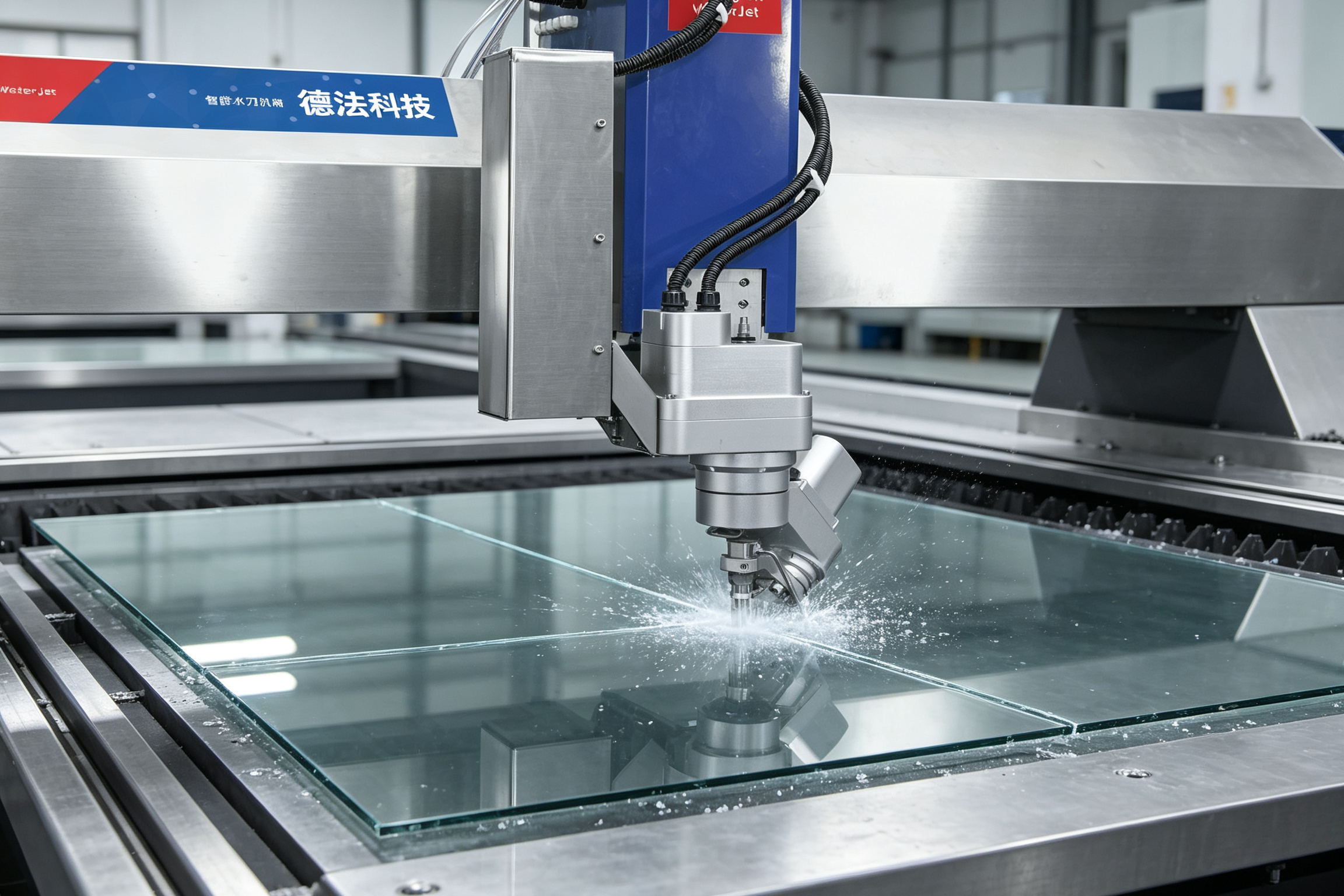
Although waterjet cutting tempered glass is generally unsuccessful, abrasive waterjet technology performs exceptionally well when processing annealed glass. Because annealed glass contains very little internal stress, the waterjet can remove material gradually without triggering catastrophic failure.
Waterjet systems can easily produce straight cuts, curved profiles, internal holes, decorative patterns, and highly complex geometries while maintaining excellent dimensional accuracy. Since the process does not generate heat, there is no risk of thermal distortion or melting around the cutting edge. The resulting edges are smooth and typically require only minimal finishing before the next manufacturing step.
This is why professional glass manufacturers always complete all cutting, drilling, slotting, and edge processing before the glass enters the tempering furnace.
The Correct Manufacturing Sequence
Successful tempered glass fabrication depends on following the proper production sequence. Instead of attempting to modify tempered glass after heat treatment, manufacturers complete every machining operation while the material remains in its annealed condition.
During this stage, abrasive waterjet cutting offers distinct advantages because it allows designers to create complex shapes that would be difficult or impossible using conventional cutting methods. Holes for hardware, decorative openings, tricky contours, and custom patterns can all be produced with high precision.
After cutting is complete, the edges are carefully polished or ground to remove chips and microscopic cracks. Proper edge finishing is especially important because even tiny imperfections can become fracture initiation points during the tempering process. Once the glass has been fully machined and inspected, it is transferred to the tempering furnace where it receives its final strength.
Following this manufacturing sequence ensures both dimensional accuracy and long-term structural reliability.
Challenges of Modifying Existing Tempered Glass
One of the most common requests received by glass fabricators is to resize or modify an already tempered panel. Unfortunately, this is rarely possible. Whether the goal is shortening the panel, drilling a mounting hole, or adding a notch, nearly every machining operation will cause the glass to break immediately.
This limitation creates several manufacturing challenges. First, any dimensional errors discovered after tempering usually require an entirely new panel rather than a simple modification. Second, production costs increase because damaged tempered glass cannot typically be repaired or reused. Finally, attempting to machine tempered glass creates unnecessary safety risks due to the sudden release of stored energy when the glass fractures.
These challenges emphasize the importance of accurate engineering drawings, careful design verification, and precise fabrication before tempering begins.
Alternatives to Waterjet Cutting Tempered Glass
When modifications are required, manufacturers generally choose alternative solutions rather than attempting to cut tempered glass directly.
The most reliable approach is to reproduce the glass component from the beginning. A new sheet of annealed glass is first cut to the required dimensions using waterjet technology, all necessary holes and cutouts are completed, and the edges are finished before the panel is tempered. Although this process requires additional manufacturing time, it ensures that the finished product maintains its full structural integrity.
In some applications, laminated safety glass may also provide a suitable alternative. Laminated glass consists of multiple layers bonded together with an interlayer and offers excellent impact resistance while allowing greater design flexibility during manufacturing. Depending on project requirements, annealed glass may also be considered if high-impact safety performance is not essential.
Perhaps the most effective alternative is simply improving product design during the early development stage. By incorporating every required feature into the original CAD model, manufacturers eliminate the necessity for costly post-tempering modifications and greatly reduce production waste.
When Waterjet Cutting Is the Best Choice
Although tempered glass cannot normally be cut after heat treatment, waterjet technology remains one of the most versatile solutions for glass fabrication. It is particularly valuable for custom architectural glass, decorative panels, furniture components, display cases, and industrial glass parts that require complex geometries or tight tolerances.
Compared with conventional cutting methods, abrasive waterjet systems provide superior flexibility while maintaining excellent edge quality. The absence of heat also minimizes residual stress and helps preserve the optical quality of the glass. For manufacturers producing customized glass products, waterjet cutting offers an ideal combination of precision, efficiency, and material versatility—as long as the machining is completed before tempering.
Conclusion
Although many manufacturers search for solutions related to waterjet cutting tempered glass, the reality is that fully tempered glass cannot typically be cut without complete failure. The internal stress created during the tempering process makes even the precise, cold-cutting action of an abrasive waterjet sufficient to trigger instantaneous fragmentation.
The most practical and cost-effective approach is to perform all cutting, drilling, shaping, and edge finishing operations while the glass remains annealed, followed by tempering as the final manufacturing step. By understanding the limitations of tempered glass and planning fabrication accordingly, manufacturers can achieve higher product quality, lower material waste, and more efficient production while fully benefiting from the precision of modern waterjet cutting technology.
Recent Posts
- Invitation | DEFA TECHNOLOGY invites you to visit
- Foshan DEFA Technology Co., Ltd invites you to participate in the GLASSTEC Düsseldorf Glass Fair in Germany in 2024
- Foshan DEFA Technology Co., Ltd invites you to participate in the Glasstech Asia & Fenestration Asia in Indonesia in 2025
- Hannover MESse Shanghai 2024
- Cutting product display
SUBSCRIBE
INQUIRY