
Why Use a Water Jet Cutting Machine for Tiles
As the demand for premium ceramic, porcelain, and natural stone tiles continues to grow, manufacturers and fabricators are expected to deliver increasingly precise and customized products. From large-format porcelain slabs to fancy mosaic patterns, modern tile projects require cutting solutions that combine accuracy, efficiency, and versatility. Traditional cutting equipment often struggles to meet these expectations, especially when processing hard or fragile materials.
A water jet cutting machine for tiles has become one of the most trusted technologies in the tile industry because it provides exceptional cutting precision without introducing heat or excessive mechanical stress. Whether producing straight cuts, complex curves, decorative inlays, or custom shapes, waterjet technology enables manufacturers to achieve consistent, high-quality results while minimizing material waste.
This article explains why more tile manufacturers and fabrication shops are choosing water jet cutting machines and how this technology improves both production efficiency and finished product quality.
Cold Cutting Protects Tile Quality
One of the biggest advantages of a water jet cutting machine is its cold-cutting process. Unlike laser or plasma cutting, waterjet technology does not generate heat during machining. Instead, it uses an ultra-high-pressure stream of water, often mixed with abrasive garnet, to cut through hard materials with remarkable precision.
This heat-free process preserves the original properties of the tile. Ceramic glazes remain intact, natural stone retains its structural strength, and delicate materials are far less likely to develop cracks or discoloration. For premium porcelain slabs and decorative stone, maintaining the original appearance is critical, making waterjet cutting the preferred solution for high-value projects.
Because there is no heat-affected zone, manufacturers can confidently process expensive materials without worrying about thermal damage that may require costly replacements.
Exceptional Precision for Modern Tile Designs
Architectural and interior design trends increasingly feature customized tile layouts, geometric patterns, and decorative installations. These applications demand a level of precision that conventional tile saws often cannot achieve.
A CNC water jet cutting machine follows digital CAD drawings with outstanding accuracy, allowing manufacturers to reproduce even the most complex designs. Whether cutting circles, curves, lettering, logos, or artistic mosaics, the machine consistently delivers smooth edges and accurate dimensions.
This precision not only improves the final appearance of the installation but also simplifies assembly on-site. Tiles fit together more accurately, reducing installation time while creating smooth visual effects that enhance the overall design.
Compatible with Nearly Every Tile Material
Modern fabrication shops rarely work with a single material. A typical production facility may process porcelain one day and granite or glass the next. Investing in separate cutting equipment for each material can greatly increase production costs and reduce operational flexibility.
A water jet cutting machine solves this challenge by processing a wide variety of materials using the same equipment. Ceramic, porcelain, marble, granite, slate, limestone, quartz, engineered stone, glass, and composite decorative panels can all be cut efficiently by adjusting the cutting parameters rather than changing the machine itself.
This versatility allows manufacturers to respond quickly to changing customer requirements while maximizing equipment utilization throughout the production process.
Clean Edges Require Less Secondary Processing
Edge quality has a direct impact on both product appearance and manufacturing efficiency. Poor-quality cuts often require additional grinding, polishing, or edge finishing before tiles can be installed or shipped.
Waterjet cutting produces remarkably smooth edges with minimal chipping, even when processing brittle materials such as porcelain and natural stone. Because the cutting stream applies very little mechanical force, edge defects are distinctly reduced compared to conventional cutting methods.
The result is a cleaner finished product that often requires less post-processing, helping manufacturers shorten production cycles while reducing labor costs. For businesses producing decorative wall panels, countertops, or luxury flooring, this improvement in edge quality can provide a clear competitive advantage.
Ideal for Complex Shapes and Custom Projects
Today's construction industry increasingly values customization. Hotels, shopping centers, luxury homes, museums, and commercial buildings frequently incorporate unique tile patterns that reflect specific architectural concepts.
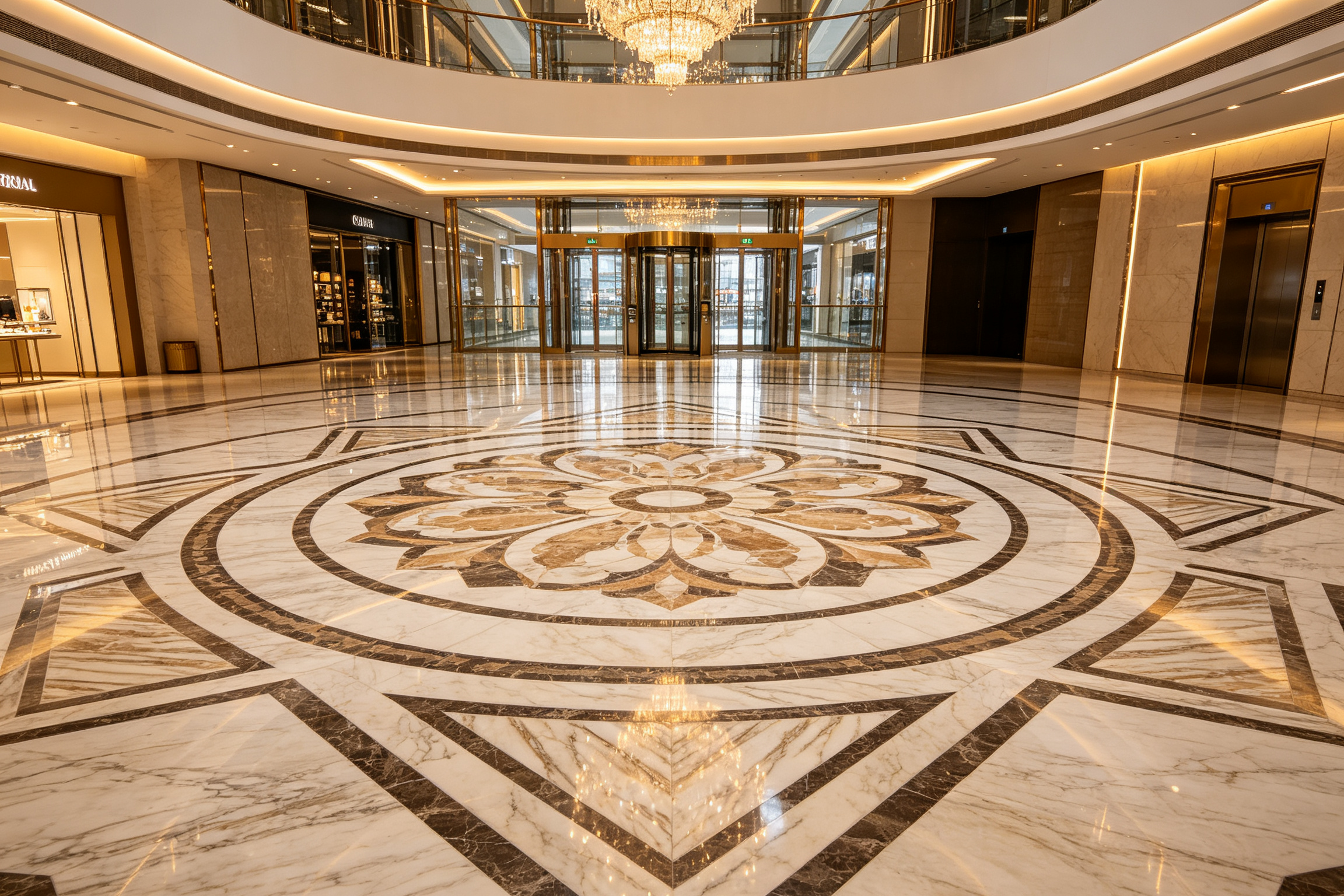
A water jet cutting machine enables fabricators to create shapes that would be extremely difficult using traditional saws. Tricky floor medallions, curved borders, decorative mosaics, custom company logos, and artistic wall panels can all be produced directly from digital drawings.
This flexibility allows manufacturers to expand beyond standard tile production and offer high-value custom fabrication services. As demand for personalized architectural designs continues to increase, waterjet technology becomes an important tool for capturing more profitable projects.
Reduce Material Waste and Lower Production Costs
Raw material costs continue to rise, particularly for premium porcelain slabs and natural stone. Every damaged tile or inaccurate cut directly affects profitability.
Waterjet cutting helps manufacturers maximize material utilization through its narrow cutting kerf and exceptional dimensional accuracy. Parts can be nested closer together, allowing more finished pieces to be produced from each slab while minimizing offcuts.
Because the process also reduces edge chipping and cutting errors, fewer tiles need to be discarded during production. Over time, these material savings can remarkably improve overall manufacturing efficiency and help offset the initial investment in advanced cutting equipment.
Perfect for Large-Format Porcelain Tiles
Large-format porcelain slabs have become increasingly popular in contemporary architecture because they create natural surfaces with fewer grout lines. However, their size and brittleness make them challenging to process using traditional cutting equipment.
Water jet cutting applies almost no mechanical stress to the material, making it particularly suitable for oversized tiles. Manufacturers can safely produce custom countertop sections, wall panels, flooring components, and bathroom surfaces without increasing the risk of cracking during machining.
As the market for large-format tiles continues to grow, waterjet technology provides the precision and reliability required for consistent production.
Automation Improves Productivity
Modern water jet cutting machines are equipped with CNC control systems that simplify production while improving consistency. Operators simply import CAD files, define the cutting parameters, and allow the machine to perform the cutting process automatically.
Automation reduces dependence on manual skills while ensuring every tile is produced according to the same specifications. This consistency is particularly valuable for manufacturers producing large production runs or supplying projects where every component must fit perfectly.
Higher productivity, shorter setup times, and repeatable cutting quality make CNC waterjet systems an excellent investment for companies seeking greater operational efficiency.
A Sustainable Solution for Modern Manufacturing
Environmental responsibility has become an important consideration for manufacturers worldwide. Waterjet cutting supports sustainable production because it generates no harmful fumes, smoke, or heat-related emissions during operation.
Many modern systems also incorporate water recycling technologies that hugely reduce water consumption. Combined with improved material utilization and lower scrap rates, these features help manufacturers reduce both environmental impact and operating costs.
For businesses looking to strengthen their sustainability initiatives while maintaining high production standards, waterjet technology offers an environmentally responsible alternative to many conventional cutting methods.
Conclusion
A water jet cutting machine for tiles offers far more than precise cutting. It enables manufacturers to process a wide variety of materials while preserving their structural integrity, improving edge quality, and supporting highly customized architectural designs. Its cold-cutting process eliminates thermal damage, while CNC automation ensures consistent accuracy across every production run.
As demand continues to grow for large-format porcelain, decorative stone, and customized tile installations, investing in advanced waterjet technology allows fabrication shops to increase productivity, reduce material waste, and deliver premium-quality products that meet the highest industry standards. For companies focused on long-term competitiveness and manufacturing excellence, a water jet cutting machine is one of the most valuable additions to a modern tile production facility.
Recent Posts
- Invitation | DEFA TECHNOLOGY invites you to visit
- Foshan DEFA Technology Co., Ltd invites you to participate in the GLASSTEC Düsseldorf Glass Fair in Germany in 2024
- Foshan DEFA Technology Co., Ltd invites you to participate in the Glasstech Asia & Fenestration Asia in Indonesia in 2025
- Hannover MESse Shanghai 2024
- Cutting product display
SUBSCRIBE
INQUIRY