
Why Waterjet Cutting Delivers Better Edge Quality
Edge quality is one of the most important indicators of a successful cutting process. Smooth, precise edges reduce the necessity of secondary finishing, improve assembly accuracy, and help manufacturers produce high-quality products more efficiently. Whether cutting stainless steel, aluminum, titanium, glass, ceramics, or natural stone, manufacturers are constantly looking for cutting methods that can deliver clean edges while minimizing production costs.
Among the various industrial cutting technologies available today, waterjet cutting stands out for its ability to produce exceptional edge quality across a wide range of materials. Unlike laser, plasma, or oxy-fuel cutting, waterjet cutting uses an ultra-high-pressure stream of water—often mixed with abrasive particles—to remove material without generating heat. This cold cutting process preserves the integrity of the material while creating smooth, accurate edges that often require little or no additional finishing.
Understanding Edge Quality in Manufacturing
Edge quality refers to the condition of a material's cut surface after machining. Smooth surfaces, accurate dimensions, minimal taper, and the absence of burrs, cracks, or thermal damage characterize high-quality edges. Good edge quality not only improves the appearance of finished products but also enhances assembly precision, welding performance, and long-term durability.
Poor edge quality, on the other hand, often results in additional grinding, polishing, or machining. These secondary operations increase labor costs, extend production time, and reduce manufacturing efficiency. For companies aiming to optimize production while maintaining consistent product quality, selecting a cutting technology that delivers superior edge quality is essential.
Cold Cutting Eliminates Heat-Related Defects
One of the primary reasons waterjet cutting produces better edges is its cold cutting process. Unlike laser or plasma cutting, which rely on extremely high temperatures to melt or vaporize material, waterjet cutting removes material through high-pressure erosion. Since virtually no heat is introduced into the workpiece, the material's original physical and mechanical properties remain unchanged throughout the cutting process.
The absence of heat eliminates common thermal defects such as heat-affected zones (HAZ), burn marks, oxidation, discoloration, and residual stress. Thin sheet metal remains flat instead of warping, while heat-sensitive materials retain their original strength and hardness, allowing manufacturers to produce cleaner edges without compromising material performance.
For industries such as aerospace, medical device manufacturing, and precision engineering, preserving material integrity is just as important as achieving dimensional accuracy, making waterjet cutting an ideal solution.
Smooth Surface Finish Reduces Secondary Processing
A major advantage of waterjet cutting is the exceptionally smooth surface finish it produces. Modern CNC waterjet machines precisely control water pressure, abrasive flow, and cutting speed, allowing manufacturers to optimize surface quality according to their production requirements.
When cutting at slower speeds for premium-quality finishes, waterjet systems can generate remarkably smooth edges that often eliminate the step of additional grinding or polishing. This reduction in secondary processing helps manufacturers save labor, shorten production cycles, and lower overall manufacturing costs.
For decorative architectural panels, stone countertops, precision mechanical components, and custom metal fabrication, the ability to produce near-finished edges directly from the cutting machine provides outstanding competitive advantages.
Minimal Burr Formation Improves Production Efficiency
Burr formation is a common issue in many cutting processes. Mechanical cutting methods often leave sharp edges due to tool wear and material deformation, while thermal cutting methods may create slag or melted material along the cut edge.
Waterjet cutting minimizes these problems because it removes material through erosion rather than melting or shearing. As a result, cut edges are remarkably clean with little or no burr formation. Components can move directly to assembly, welding, or inspection without extensive edge preparation.
Reducing burr removal not only lowers production costs but also improves workplace safety by eliminating sharp edges that could cause injuries during handling.
Superior Dimensional Accuracy Creates Better Edges
Excellent edge quality depends not only on surface smoothness but also on dimensional precision. Modern CNC waterjet cutting systems incorporate advanced motion control software, high-precision servo motors, and intelligent cutting algorithms to maintain accurate cutting paths throughout the entire process.
Many industrial waterjet machines achieve positioning accuracy of approximately ±0.1 mm, depending on machine configuration and application requirements. This level of precision produces consistent edge profiles, tight tolerances, and reliable repeatability, even when manufacturing complex components with tricky geometries.
High dimensional accuracy reduces assembly errors, minimizes scrap, and improves overall product quality, making waterjet cutting particularly valuable in aerospace, automotive, electronics, and industrial manufacturing.
No Heat Affected Zone Preserves Material Integrity
One of the biggest disadvantages of thermal cutting technologies is the formation of a Heat Affected Zone (HAZ). During laser or plasma cutting, intense heat alters the material's microstructure near the cut edge, which can lead to increased hardness, brittleness, discoloration, and reduced fatigue resistance.
Waterjet cutting completely eliminates this issue. Since cutting occurs at nearly room temperature, there is no change to the material's internal structure. Stainless steel maintains its corrosion resistance, aluminum retains its mechanical properties, and titanium remains suitable for demanding aerospace applications.
For manufacturers producing precision components that require welding, machining, or coating after cutting, avoiding heat damage distinctly improves downstream manufacturing quality.
Excellent Edge Quality Across Thick Materials
Many cutting technologies experience declining edge quality as material thickness increases. Laser cutting, for example, performs exceptionally well on thin sheet metal but becomes less efficient on thicker materials. Plasma cutting can produce rougher edges and greater taper when cutting heavy plate.
Waterjet cutting maintains consistent edge quality across a broad range of material thicknesses. Whether processing thin stainless steel sheets or thick steel plates, granite slabs, marble blocks, or ceramic panels, the cutting process remains highly accurate and produces smooth edges.
This versatility allows manufacturers to process different materials and thicknesses using a single machine while maintaining consistent production quality.
Superior Results on Fragile and Heat-Sensitive Materials
Some materials are extremely difficult to process using conventional cutting technologies. Glass, ceramics, carbon fiber composites, laminated materials, and natural stone are all susceptible to cracking, chipping, or delamination when exposed to excessive heat or mechanical stress.
Waterjet cutting overcomes these challenges through its non-thermal cutting process. The high-pressure water stream applies relatively low cutting force while avoiding thermal expansion, allowing delicate materials to be cut with outstanding edge quality.
This capability explains why waterjet cutting has become the preferred technology for architectural glass, porcelain slabs, marble countertops, composite aerospace panels, and decorative stone products.
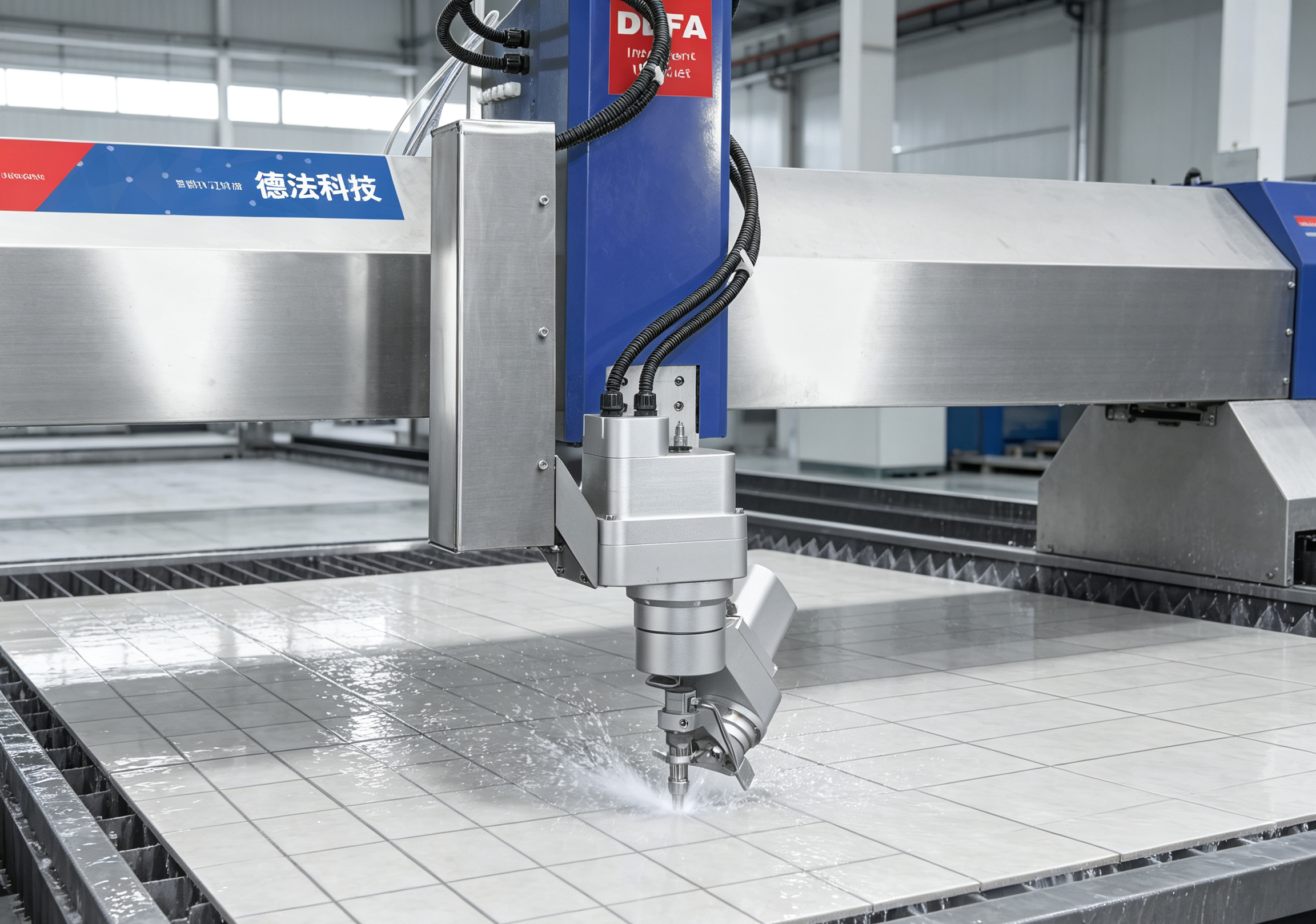
Rotary 5-Axis Technology Improves Edge Precision
Modern 5-axis waterjet cutting systems further enhance edge quality by actively compensating for natural taper during the cutting process. Traditional vertical cutting may produce slight edge angles on thicker materials due to the characteristics of the water stream.
Rotary cutting heads automatically adjust the nozzle angle throughout the cutting path, ensuring nearly vertical cut edges even on thick workpieces. This technology improves dimensional accuracy, reduces taper, and produces cleaner profiles with superior consistency.
For manufacturers producing precision machinery, aerospace components, or complex industrial parts, 5-axis waterjet systems provide an additional level of edge quality that reduces or eliminates post-processing requirements.
Reduced Material Distortion Improves Final Product Quality
Heat generated during thermal cutting often causes expansion and contraction within the material, leading to distortion, warping, or residual stress. These issues are particularly problematic when cutting thin sheet metal or precision components where flatness is critical.
Because waterjet cutting introduces virtually no heat into the material, thermal distortion is eliminated. Parts remain dimensionally stable throughout the cutting process, simplifying assembly and improving overall manufacturing accuracy.
This advantage is particularly valuable for industries requiring precise fitment, including automotive manufacturing, electronics, medical devices, and industrial equipment fabrication.
Lower Manufacturing Costs Through Better Edge Quality
Although waterjet cutting equipment may require a higher initial investment than some traditional cutting systems, its superior edge quality often results in substantial long-term savings. Clean edges reduce the risk of secondary machining, polishing, grinding, and deburring, allowing manufacturers to complete production more quickly and efficiently.
Improved cutting accuracy also reduces material waste, minimizes rejected parts, and increases overall production yield. Since waterjet cutting can process multiple materials on a single machine, manufacturers can simplify production workflows while lowering operating costs.
Over time, these efficiency gains contribute to a lower total cost of ownership and a stronger return on investment.
Conclusion
Waterjet cutting delivers better edge quality because it combines cold cutting technology, exceptional precision, and remarkable material versatility into one highly efficient manufacturing process. By eliminating heat-affected zones, minimizing burr formation, preserving material properties, and producing smooth, accurate cut surfaces, waterjet cutting enables manufacturers to achieve higher-quality products while reducing secondary processing and production costs.
Whether cutting metals, composites, ceramics, glass, or natural stone, a modern CNC waterjet cutting machine provides consistent edge quality that supports demanding industrial applications. For manufacturers focused on precision, efficiency, and long-term productivity, waterjet cutting remains one of the most reliable and cost-effective cutting technologies available today.
Recent Posts
- Invitation | DEFA TECHNOLOGY invites you to visit
- Foshan DEFA Technology Co., Ltd invites you to participate in the GLASSTEC Düsseldorf Glass Fair in Germany in 2024
- Foshan DEFA Technology Co., Ltd invites you to participate in the Glasstech Asia & Fenestration Asia in Indonesia in 2025
- Hannover MESse Shanghai 2024
- Cutting product display
SUBSCRIBE
INQUIRY